Electrical Panel Permit Inspection Checklist
This checklist covers every item a residential electrical inspector will check when inspecting a panel replacement or service upgrade. Use it before your inspector arrives to maximize your chances of passing on the first visit.
Download the PDF Version
Print-ready checklist — front and back, formatted for a clipboard. Take it to your building department or job site.
Interactive Checklist
0 / 0 completed
Common Inspection Failure Points
These are the most frequently cited items on failed residential electrical panel inspections, based on building department data and electrical inspector surveys:
🚫 #1 Most Common Failure: Missing AFCI/GFCI Breakers
Under NEC 2020 (and many jurisdictions on 2017), Arc Fault Circuit Interrupter (AFCI) protection is required on virtually all 120V circuits in habitable spaces — not just bedrooms. When you replace your panel, new AFCI breakers must be installed on kitchen, living room, dining room, bedroom, hallway, and other habitable room circuits. GFCI protection must be present on bathroom, kitchen countertop, garage, outdoor, and other wet-area circuits. This is the single most common cause of failed panel inspections nationwide.
🚫 #2 Working Clearances (NEC 110.26)
Your panel must have: 30 inches of clear width, 36 inches of clear depth in front of the panel, and 78 inches of clear headroom. If shelving, water heaters, or other equipment encroach on this space, the inspector will cite a violation. Clear the area before scheduling your inspection.
🚫 #3 Improper Grounding and Bonding
The grounding electrode system — ground rod(s), metal water pipe bond, and structural steel bond where applicable — must be complete and connected to the panel's ground bar. The ground bar and neutral bar must be bonded together at the main panel (but separated at sub-panels). Grounding errors are cited frequently and can require significant rework.
🚫 #4 Unlabeled or Incomplete Circuit Directory
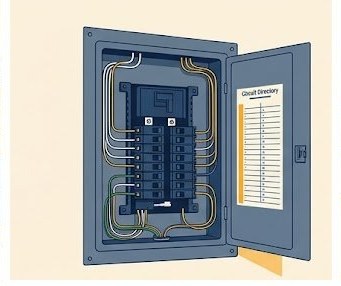
Every circuit in the panel must be identified on the directory card inside the panel door. "Bedroom 1," "Kitchen Refrigerator," "Garage," etc. Blank spaces or "unknown" labels are a citation. Label everything before the inspection.
🚫 #5 Open Knockouts
Any unused knockouts in the panel enclosure must be closed with listed fillers. A single open 1/2" knockout is a fire hazard and an NEC violation. Walk around the entire panel enclosure and fill every unused opening before inspection.
Pre-Application Checklist: Before You Apply for the Permit
Before you visit the permit portal, have these items ready to avoid delays:
| Item | Where to Find It | Required? |
|---|---|---|
| Property address | Your mailing address | Always |
| Parcel number (APN/PIN) | County assessor website or tax bill | Almost always |
| Current panel amperage | Printed on main breaker | Usually required |
| New panel amperage | Your purchase decision / electrician spec | Usually required |
| Panel manufacturer/model | Panel spec sheet or box | Sometimes |
| Estimated project value | Your best estimate ($1,500–$3,500 typical) | For fee calculation |
| Owner-builder declaration form | Building dept. website or portal | If self-permitting |
| Proof of ownership | Deed, title, or tax statement | Some jurisdictions |
Inspection Checklist FAQ
Yes — someone with knowledge of the work must be present for the inspection. The inspector needs access to the panel, may have questions about the installation, and must be able to confirm the permit is posted. You don't need to be the homeowner specifically, but it should be someone who can speak to the work (you, a family member who helped, etc.).
Yes — failing a first inspection is common and not a serious problem. The inspector will provide a written list of corrections. Fix the items cited, then schedule a re-inspection. Most jurisdictions allow one or two free re-inspections; additional ones may cost $25–$75. Do not cover or conceal any work until you have a passing inspection.
This depends on your state and county. Most U.S. jurisdictions are currently using NEC 2017, NEC 2020, or NEC 2023. California uses the 2022 California Electrical Code (based on NEC 2020). Florida uses the Florida Building Code 7th Edition (also NEC 2020-based). Texas jurisdictions vary widely — some use 2017, some 2020. Your permit approval will specify which code applies, and your building department can tell you before you apply.
Disclaimer: This checklist is a general guide based on common NEC requirements. Your specific jurisdiction may have additional local amendments. Always confirm requirements with your local building department before starting work.